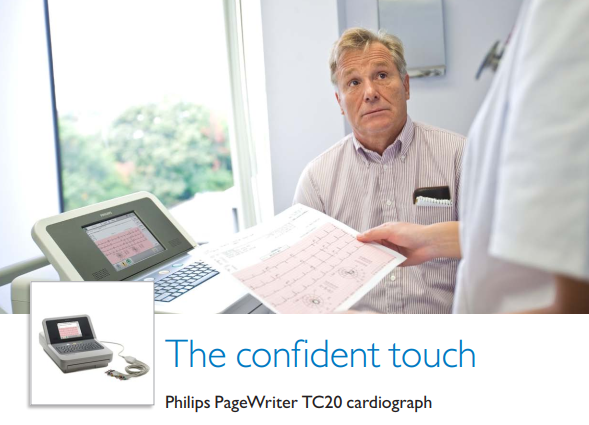
The PageWriter TC20 is advanced, easy to use, and affordable without compromising your evolving workflow needs. The 1-2-3 touch operation leads you through acquisition, analysis, storage, printing and accessing previous ECGs with ease. Further enhancing workflow, worklists and patient demographics can be downloaded leveraging current technologies, using wired or wireless LAN, via standard XML, HL7, and DICOM communications. The TC20 also provides the world-class DXL Algorithm with industry-leading clinical decision support. Confidence is ensured into
the future with a standard multi-year warranty.
Features – PageWriter TC20 Cardiograph (860332)
| ECG functions | |
|---|---|
| Simultaneous lead acquisition | 12 leads. |
| ECG reports |
|
| Standard measurements |
|
| Rhythm strips | Up to 12 configurable leads. |
| Disclosure (D05) |
|
| Event marking (D05) |
|
| Timed ECG | Support for pharma stress protocols |
| Report storage and transfer | Full fidelity at 500 Hz of 10 second and for all 12 leads |
| Report format | PDF or XML formats |
| DXL ECG Algorithm (D03) | |
| Interpretive statements |
|
| Borderline statement suppression | Three configurable settings |
| Extended measurements |
|
| Reasons | Selectable explanations of all interpretive statements |
| Nomenclature | Aligned with 2007 AHA/ACCF/HRS Recommendations, Part II |
| STEMI diagnostic aids | |
| Graphical ST presentation |
|
| Age and gender criteria (D03) | Based upon 2009 AHA/ACCF/HRS Recommendations, Part VI: Acute Ischemia/Infarction |
| STEMI-CA (Culprit Artery)(D03) |
|
| Critical Values (D03) | Highlights 4 conditions requiring immediate clinical attention |
| Advanced bi-directional network communications | |
| Central time management(D01) |
|
| Orders Worklist(D01) |
|
| ADT(D02) |
|
| Last ECG (D06) |
|
| Interactive Query (D06) |
|
| Manual orders (D07) | Create patient worklists with complete demographic information for later retrieval |
| Create patient worklists with complete demographic information for later retrieval | |
| Leads off advisory | Anatomical lead map displays the location and label of loose or disconnected leads/electrodes |
| Lead color | Four colors to indicate quality of individual leads |
| Lead check | Lead placement software detects 20 different lead reversals |
| Heart rate | Continuous display of patient heart rate |
| Print preview | Full screen preview of ECG waveforms prior to printing |
| User training and self-help | |
| Application help | Integrated graphical Help for primary functions |
| Self-paced training | PC based, interactive, dynamic animation covering all major clinical functions |
| Training mode | Integrated waveform simulation |
Technical Specifications
| User interfacem | |
|---|---|
| Touchscreen |
|
| Keyboard |
|
| Membrane keyboard cover | Silicone based flexible cover protects keyboard from particulate and liquid ingress |
| Display | |
| Size | 6.5˝ TFT active matrix |
| Resolution | 640 x 480 VGA. |
| Colors | 64K colors |
| Patient Connections | |
| Patient cable | Acquire data at 8000 samples/second on each patient connect |
| Long patient cable(H23) | Extended length lead wires enabling greater distances between the patient cable and the patient connections |
| End Connectors (Adaptors) | |
| Alligator clips (E01) | Alligator clips for tab electrodes |
| Wide tab (E02) | Flat adaptor for tab electrodes minimizes twisting (AAMI only) |
| Pediatric clips (E03) | Lightweight lead extenders for infant and pediatric applications |
| Welsh bulbs (E04) | 6 Welsh bulbs and 4 limb clamps |
| Snap/Tab adaptor (E06) | Fits both snap and tab electrodes with metal on both sides |
| Printer | |
| Resolution | High-resolution, digital-array printer using thermal-sensitive paper; 200 dpi (voltage axis) by 500 dpi (time axis) at 25 mm/sec |
| Connectivity | |
| LAN (D20) | 10/100 Base-TX IEEE 802.3 ethernet via on-board RJ45 |
| Wireless LAN (D23) | 802.11(b/g) |
| Internal storage (D06) | 200 ECGs |
| External storage | 200 ECGs with optional USB device |
| Automated data input | |
| Bar code reader (H12) |
|
| Magnetic card reader (H13) |
|
| Smart “IC” card reader (H14) |
|
| Pre-processing filters | |
| AC noise | 50 or 60 Hz |
| Signal processing | Artifact Rejection and Baseline Wander |
| Presentation filters – 10 sec reports | |
| High pass | 0.05, 0.15 and 0.5 Hz |
| Low pass | 40, 100 and 150 Hz |
| Presentation filters – rhythm | |
| High pass | 0.05 and 0.15 Hz |
| Low pass | 40, 100 and 150 Hz |
| Electrical | |
| Battery | Lithium ion |
| Battery capacity |
|
| Battery recharge | 4 hours to full capacity |
| Mains power | 100-240 VAC, 50/60 Hz |
| Power consumption | 60 W max |
| Mechanical | |
| Dimensions | 31 x 40 x 21 cm ( 12 x 16 x 8 in) |
| Weight | 8.6 kg (19 lb) includes battery, patient cable |
| Environmental | |
| Operating conditions | 10° to 40°C (50°F to 104°F); 10% to 90% relative humidity (non-condensing); Up to 4,200 m (14,000 ft.) altitude |
| Storage conditions | -20°C to 50°C (-4°F to 122°F); 10% to 90% relative humidity (non-condensing); Up to 4,550 m (15,000 ft.) altitude |
| Safety and performance | |
| International standards and regulations |
|